1.2 million
Annual Visitors
4,250 objects from the Acropolis
Collection
2 hours
Recommended Visit
Bernard Tschumi Architects (2009)
Architect
About Acropolis Museum
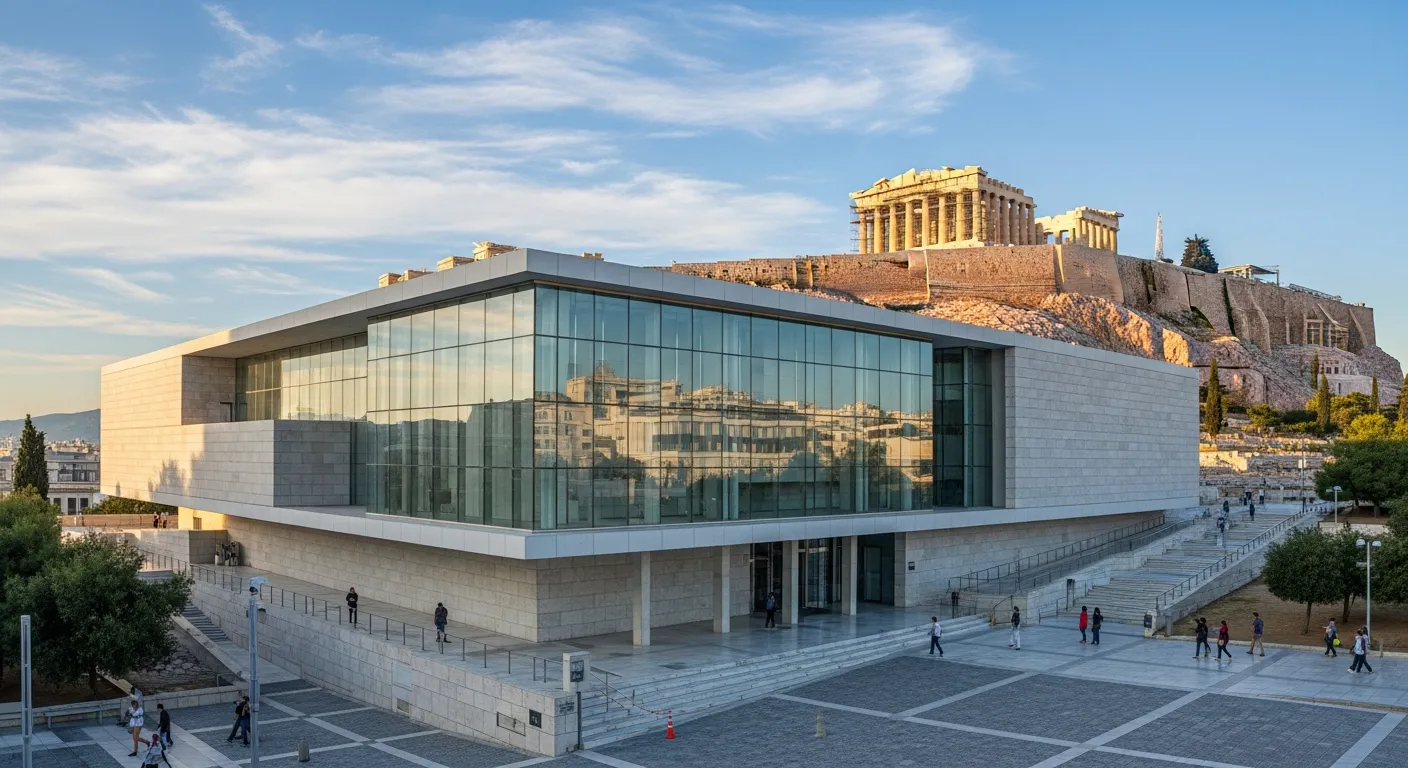
The Acropolis Museum is an archaeological museum focused on the findings of the archaeological site of the Acropolis of Athens. The museum was built to house every artifact found on the rock and on its feet, from the Greek Bronze Age to Roman and Byzantine Greece.
It opened to the public on 20 June 2009 and was designed by Swiss-French architect Bernard Tschumi with the collaboration of Greek architect Michael Photiadis. The building's top level mirrors the orientation and dimensions of the Parthenon, which it directly overlooks.
The museum is built over an extensive archaeological site, much of which is visible through transparent floors. Glass throughout the building allows views of the Acropolis, integrating the museum into its historical context.
It plays a central role in the international debate over the return of the Parthenon Sculptures (Elgin Marbles) currently held by the British Museum, with the top-floor Parthenon Gallery designed to display them in their original arrangement.
Masterworks & Must-See Highlights
The works that define Acropolis Museum — and why they matter.
Caryatid Porch (five of six Caryatids)
Pheidias workshop · c. 421–406 BCE
Level 3, Parthenon Gallery
Five of the six original carved maidens (Caryatids) who served as architectural columns on the Erechtheion porch. The sixth is in the British Museum — the Acropolis Museum displays a cast in her place as a reminder of the separation.
Parthenon Frieze (fragments)
Pheidias and workshop · c. 447–432 BCE
Level 3, Parthenon Gallery
The museum's centrepiece: original sections of the Parthenon frieze displayed in their original orientation around the cella of a glass building aligned with the Parthenon above. The visible gaps filled with plaster casts mark the pieces in London.
Kritios Boy
Kritios (attr.) · c. 480 BCE
Level 2, Archaic Gallery
One of the earliest examples of contrapposto — the slight hip-shift and turn that would revolutionise Greek sculpture and eventually Renaissance art. A transitional work between the rigid Archaic kouros type and the naturalistic Classical style.
Collections & Highlights
Frequently Asked Questions
A small ask before you go
You've just explored one of humanity's greatest collections of beauty. Art has the power to move us, inspire us, and change how we see the world. But millions of people will never see beauty like this — not because the art isn't there, but because they can't see at all.
Preventable blindness, caused by conditions like cataracts and trachoma, affects people of all ages across the world's poorest communities. A small gift — for the cost of a museum ticket — can provide a simple surgery to restore someone's sight and transform their life.