9.7 million
Annual Visitors
480,000 objects; 35,000 on display
Collection
3–5 hours
Recommended Visit
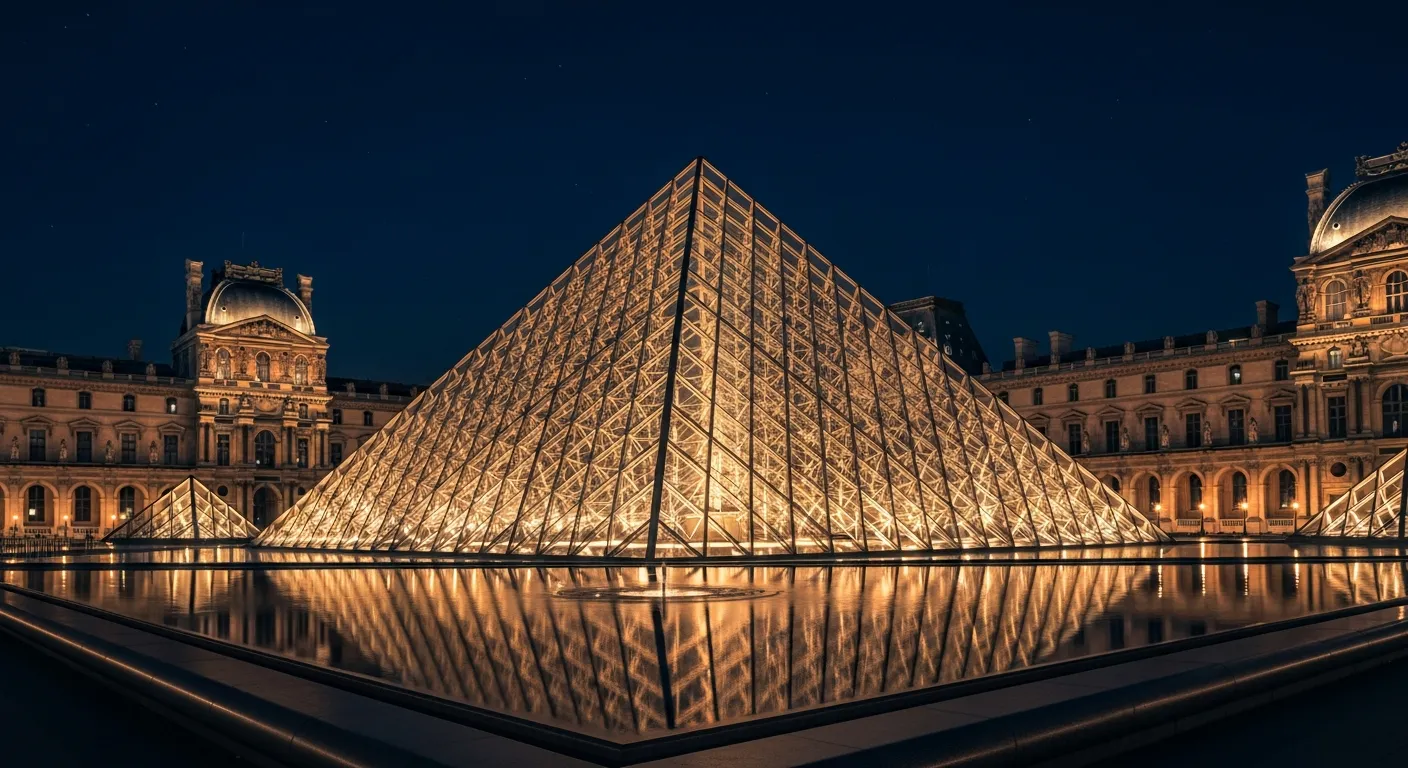
I. M. Pei (Glass Pyramid, 1989)
Architect
About The Louvre
The Louvre is the world's largest art museum and a historic monument in Paris, France. A central landmark of the city, it is located on the Right Bank of the Seine in the city's 1st arrondissement.
The museum is housed in the Louvre Palace, originally built in the late 12th to 13th century under Philip II. Remnants of the fortress are visible in the basement of the museum. Due to urban expansion, the fortress eventually lost its defensive function, and in 1546 Francis I converted it into the primary residence of the French Kings.
The building was extended many times to form the present Louvre Palace. In 1682, Louis XIV chose the Palace of Versailles for his household, leaving the Louvre primarily as a place to display the royal collection.
During the French Revolution, the National Assembly decreed that the Louvre should be used as a museum to display the nation's masterpieces. The museum opened on 10 August 1793 with an exhibition of 537 paintings, the majority of the works being royal and confiscated church property.
Masterworks & Must-See Highlights
The works that define The Louvre — and why they matter.
Mona Lisa
Leonardo da Vinci · c. 1503–1519
Salle des États, Room 711, Denon Wing
The world's most visited painting. A portrait believed to depict Lisa Gherardini, painted in oil on poplar wood. Its sfumato technique, enigmatic expression, and 1911 theft propelled it to global celebrity.
Venus de Milo
Unknown Greek sculptor · c. 130–100 BCE
Gallery 346, Sully Wing
An ancient Greek marble sculpture representing Aphrodite (Venus), goddess of love. Discovered on the island of Milos in 1820, it is celebrated as one of the greatest achievements of ancient Greek sculpture.
Winged Victory of Samothrace
Unknown Greek sculptor · c. 200–190 BCE
Top of the Daru Staircase, Denon Wing
A marble sculpture of Nike (Victory) poised on the prow of a ship. The masterpiece is prized for its dramatic forward momentum and extraordinarily naturalistic drapery.
Liberty Leading the People
Eugène Delacroix · 1830
Room 700, Denon Wing
Delacroix's iconic Romantic canvas commemorating the July Revolution. The allegorical figure of Liberty holding a tricolour has become one of the most recognisable images of freedom in Western art.
The Wedding at Cana
Paolo Veronese · 1562–1563
Salle des États, Room 711, facing the Mona Lisa
The largest painting in the Louvre at 677 × 994 cm. Veronese's monumental canvas depicts Christ's first miracle at a lavish Venetian banquet, with over 130 figures including portraits of Titian and Tintoretto.
Collections & Highlights
Frequently Asked Questions
You Might Also Like
A small ask before you go
You've just explored one of humanity's greatest collections of beauty. Art has the power to move us, inspire us, and change how we see the world. But millions of people will never see beauty like this — not because the art isn't there, but because they can't see at all.
Preventable blindness, caused by conditions like cataracts and trachoma, affects people of all ages across the world's poorest communities. A small gift — for the cost of a museum ticket — can provide a simple surgery to restore someone's sight and transform their life.